Pick of the Week – Volume 87

Joden Girl

Baubles, Bling and Discounted Things

The turn of the 20th century was a magical time in the jewelry world.  Three unique periods collided to create some of the most iconic jewels of all time.  Technically, the Victorian era ended with the death of Queen Victoria on January 22, 1901 – however, her influence reached far into the 1900’s.  The Art Nouveau period has been recorded as the years between 1890-1910 – just two short decades, but arguably one of the most important periods.  Concurrently, the Edwardian era lasted from 1901-1910.  You don’t have to try to imagine the beauty that can come from three exemplary periods coming together, we can show you…

Utterly feminine, this small brooch exemplifies characteristics of the Victorian, Art Nouveau and Edwardian times.  The base of the piece is yellow gold that has been topped with a thin layer of platinum, a detail often seen in the very early 1900’s.  The platinum has been micro-set with sixty-four rose cut diamonds that offer .75 carat of twinkling sparkle.  This primitive cut was prevalent in the mid to late 1800’s.  The rough material was fashioned with a flat back and a faceted, rounded top.  Due to its resemblance to a flower, it was dubbed a “rose cut”.  

Enclosed inside the diamond halo and protected with a thin, glass crystal is a whimsical painting of a young woman. These kinds of paintings and elaborate enamel works often featured the female form and were all the rage in the Art Nouveau period.  Enjoying a breezy day, she is having an afternoon dalliance with a pair of dragonflies.  Her scarf billows out behind her while her dress blows against her legs, gathering behind her.  Both of her arms are raised; her hands acting as a tether for the two kite-like dragonflies.  Like a great conductor, she is guiding the ethereal insects along a melodious gust of wind.  

This brooch is in excellent condition, and has been part of our antique collection for quite some time, priced at $4500.00.  In our efforts to bring back the brooch, we are now offering it for just $2,950.00.  Already an antique, this beauty is sure to be a treasured family heirloom for generations yet to come.  

“You can go to a museum and look, or come to us and touch.”

Written by Carrie Martin

Photos by Dana Jerpe

Joe’s Special Box Luxury Edition – Volume 13

Joden Girl

Baubles, Bling and A Collector’s Things

If you have visited our showroom at 144 South Broad Street, you no doubt have perused one or more of the antique jewelry cases at the back of the store.  Each one is more enticing than the last, overflowing with Victorian and Art Deco treasures.  There is one case that stands out from all the others…  we affectionately refer to it as “the museum case”.  And while the case itself was most likely made in the 1950’s, each of the thirty-eight pieces contained inside are indeed museum quality.  Lovingly curated over the past three decades, our collection of the works of Carlo Giuliano most certainly rival any other.

Born in Italy in 1831, Giuliano emigrated to London in 1860.  He partnered with another well-known Italian jeweler, Castellani.  Inspired by archaeological jewelry, in the early days, his work was largely done in a revivalist style.  He retailed his wares through respected and established firms like C. F. Hancock and Robert Phillips.  By 1874, his reputation had grown and he was able to open a retail shop entirely his own at 115 Piccadilly.  Giuliano’s tiny establishment was filled with enameled jewels decorated with unusual gemstones.  His superb work stood out in stark contrast to other artists.  His meticulous attention to detail came to life in his Renaissance aesthetic and paired beautifully with Giuliano’s flair for contemporary wear-ability resulting in unparalleled creations.  

This locket is our most recent acquisition.  Purchased from our friends in London (who know Joe is an avid collector of Giuliano’s works); this near-mint condition pendant showcases the intricate patterns of enameling that Giuliano’s masterpieces are recognized for.  The stark white enamel complements the soft blue tones and provide an ideal background for countless microscopic deep-blue dots.  Executed in a medallion style with an eight-petaled blossom in the center, the design swirls out in graduating curls and whorls.  The border fully encapsulates the locket with a repeating fancy figure-eight-shape.  

Inside is a watercolor portrait miniature of Sir William Lawrence.  The aforementioned gentleman was quite well known…  a 1st Baronet FRCS FRS, an English surgeon, Fellow of the Royal Society, President of the Royal College of Surgeons of London and Sergeant-Surgeon to Queen Victoria.  She would later reward his illustrious career as a surgeon with a baronetcy shortly before his death.  

On the back side, encased beneath a glazed glass compartment is a lock of Sir William’s hair, complete with a small decorative wire to hold the golden curl in place.  Also, peep the little golden oval carefully soldered to the top of the frame.  It features the initials C. G. and is the hallmark for Carlo Giuliano.  As not all of his works were signed, this emblem is a significant find.  The entire pendant nestles into a deep purple velvet case that also bears the mark of Giuliano. 

For inquiring minds, this historical piece is for exhibition only.  We are honored to be the stewards of such a noteworthy jewel and were tickled to add it to our extensive collection.

“You can go to a museum and look, or you can come to us and touch.”

Written by Carrie Martin

Photos by Dana Jerpe

Pick of the Week – Volume 56

Joden Girl

Baubles and Bling with Unbelievable Pricing

In the Victorian era (1837-1901), the diamond was not the most popular choice for engagement rings.  In fact, more often than not, the recipient’s birthstone was chosen for the occasion.  Queen Victoria’s ring was no exception.  Designed by Albert, it was an 18-karat yellow gold serpent that wrapped around her finger.  The sinuous snake showcased ruby eyes, a diamond mouth…  and an emerald set in its head.  Born on May 24th, 1819, the emerald was Victoria’s birthstone.  

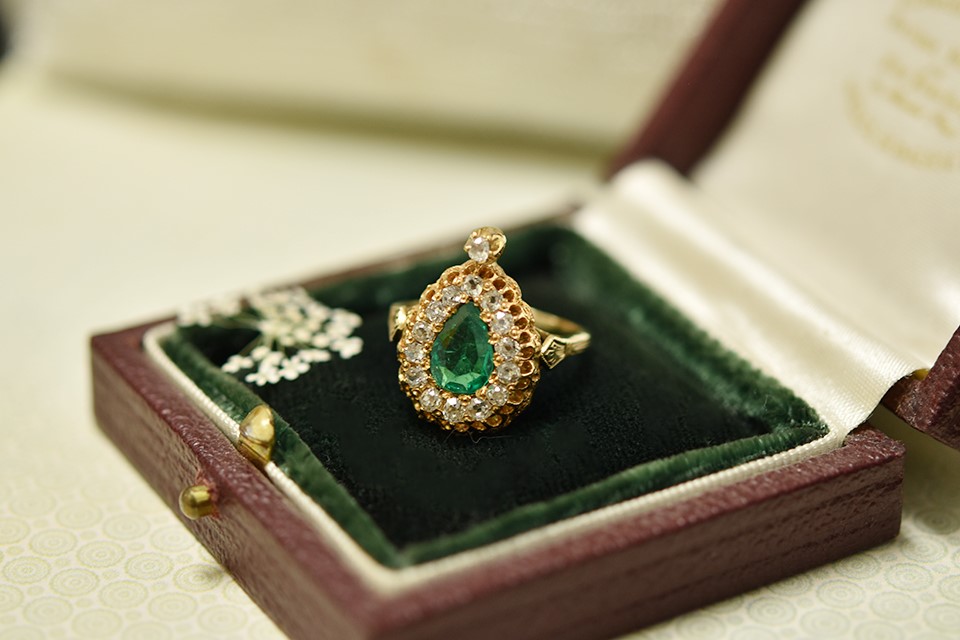
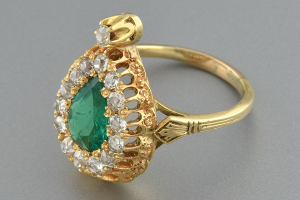
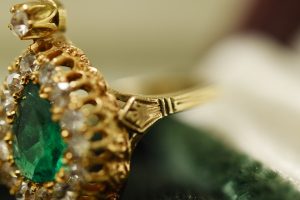
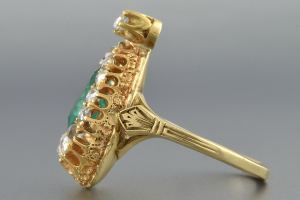
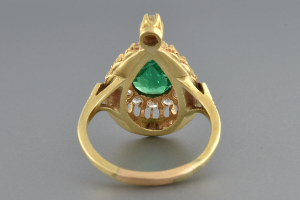
Perhaps this ring was originally created for the same purpose…  it would have been a lovely betrothal ring.  Made in the late Victorian era, this curvaceous charmer was constructed from 14-karat yellow gold.  The center boasts a bright green pear-shaped emerald that weighs approximately 1.25 carats.  

Gem fine, the color tone and saturation are stellar and can only be described as emerald green.  While the stone is not flawless, it’s reasonably clean – a rarity for an emerald.  Just like diamonds, colored stones are graded using the Four C’s…  color, cut, clarity and carat weight.  As you might suspect, color is the most important “C” for colored gems.  In regard to emeralds, clarity ranks a close second.  To have both outstanding color and superb clarity is nearly unheard of.  

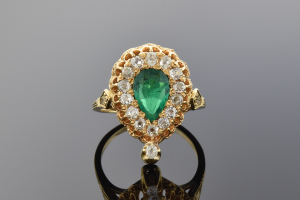
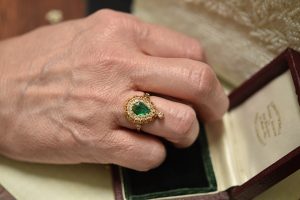
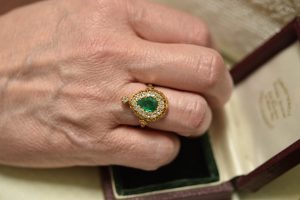
Surrounding the emerald are fourteen Old Mine Cut diamonds.  One additional stone crowns the tip.  Together, these diamonds have a total weight of .75 carat.  An antique beauty, this ring is an exceptional example.  It has presented one question…  would you wear it with the point up?  Or point down?

It looks lovely either way.  There’s no right or wrong answer, merely personal preference.  If you’re lucky enough to own this ring, you can wear any way you want! 

This beauty is an old friend…  we’ve had it for a while.  It’s been on our website longer than most – priced at $7200.00.  We recently selected it as the latest Pick of the Week and are offering it now for just $3,950.00!  That’s a savings of over forty percent.  Whether you wear it on your left hand or right – point up or point down, this is a ring that is begging to be worn.  Take advantage of these incredible savings.  Hop over to our site and add it to your cart today. 

“You can go to a museum and look, or come to us and touch.”

Written by Carrie Martin

Photos by Dana Jerpe and Shelly Isacco

Click To Call!